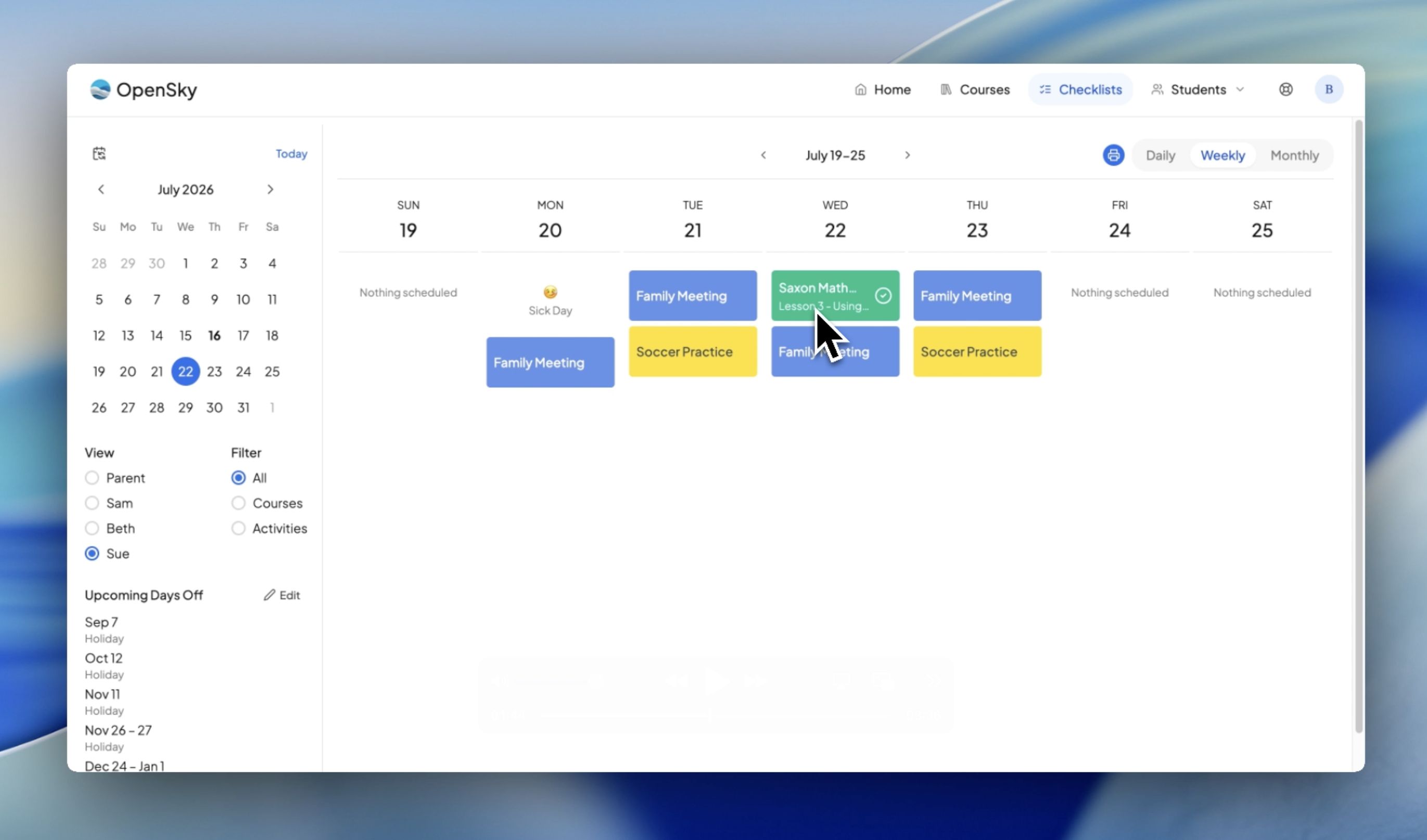
A quick thought experiment.
It's the first week of school. On day three, one of your kids gets sick. The next week, the family decides Thursday is a zoo day.
Two totally normal events, barely into the year. If this happened, how outdated would your plan be? How much time would you have to spend rescheduling to make it accurate again?
If the answer is more than a minute, your plan is brittle.
Paper planners, spreadsheets, and tools like Trello all solve the same short-term problem: I'm anxious because I don't know what we're doing next week, and I need the plan out of my head and onto paper. They solve it well. That's why homeschool parents keep reaching for them. But the thought experiment exposes the flaw: the moment anything changes, the plan doesn't adjust. It breaks. How your planning system handles change determines whether it protects your sanity long-term, or quietly erodes it.
The brittleness problem
A brittle plan is one that shatters on contact with real life. And handwritten planners, spreadsheets, and general-purpose tools like Trello are brittle by design, because none of them can automatically adapt to the serendipity of homeschooling.
To a spreadsheet, your homeschool year is just a grid of cells. To a paper planner, it's ink on dated pages. To Trello, it's cards in columns. None of these tools know that Lesson 12 comes after Lesson 11, that Tuesday's sick day means everything downstream needs to shift, or that dropping a curriculum in November means erasing six months of penciled-in entries.
In a homeschool, life happens constantly. A kid gets the flu for a week. A math curriculum that looked perfect in August turns out to be a terrible fit by October. Grandma visits. You find out about an amazing class that meets Thursday mornings. Each of these triggers hours of erasing, re-dating, dragging cards, and copying cells.
When the cost of change is hours of manual rework, two predictable failure modes emerge. Both are worse than the anxiety you started with.
Failure mode #1: You become resistant to change
If every adjustment costs you a Sunday afternoon, you stop making adjustments. Not consciously, but you just start finding reasons why the curriculum that isn't working is "probably fine," why the spontaneous field trip "doesn't really fit this week," why the new class can wait until next year. The plan stops serving the child and the child starts serving the plan.
This is exactly backwards from what experienced homeschoolers say matters most. Oak Meadow, one of the oldest homeschool curriculum providers in the country, puts flexibility at the very center of the model: the freedom to dive deep into a topic, to travel, to seize unexpected opportunities, and to slow down when a child signals they're overwhelmed. Children tell us when they need to slow down or speed up, but only a parent whose plan can absorb and reflect that can actually act on it.
Educator and author Leslie Martino makes a similar point about pacing: flexible planning means treating time as a canvas rather than a taskmaster, planning in seasons rather than rigid semesters, and prioritizing peace over raw productivity. Homeschool coach Alicia Michelle wrote an entire book on this premise (it's literally titled Plan to Be Flexible) arguing that no single method or curriculum works for every family, and that your planning system has to bend as you learn what works.
And homeschool writer Laura Noelle identifies the mechanism behind the burnout: when your entire homeschool depends on everything going exactly according to plan, every sick kid, skipped nap, and flooded laundry room makes you feel like a failure. Rigid schedules don't survive real families. What many families need is flexible structure.
Here's the uncomfortable part: rigidity usually isn't a personality trait. It's a tooling problem. Parents don't resist change because they're inflexible people. They resist change because their planner makes change expensive.
Failure mode #2: You give up on planning entirely
The other path is just as common. The spreadsheet drifts out of date. The planner has a three-week gap of blank pages. Eventually you succumb to the idea that keeping this thing updated is a part-time job and you quietly stop.
In the short term, this feels like relief. No more Sunday-night maintenance sessions. But you've just traded one anxiety for a slower-burning, worse one: the anxiety of no visibility. Are we on track for the year? Did we actually cover enough science? What do we do tomorrow? You're back to carrying the whole plan in your head, which is precisely the problem you built the plan to solve.
This is the fuel line to homeschool burnout. Writers at Teach Them Diligently describe how the constant juggle of lesson planning, household management, and worry about "falling behind" drains even grounded parents — and that worry is loudest when you've lost sight of where you actually stand. iHomeschool Network notes burnout can strike at any point in the year, and it thrives in exactly this fog: chaotic days, chronic behind-ness, never knowing what's supposed to happen next.
So brittle tools push you toward one of two bad outcomes: a rigid plan you're afraid to touch, or no plan at all. Either way, your sanity pays.
What a non-brittle planning system looks like
The answer isn't to plan less, or to plan harder. It's to use a system where change is cheap. A purpose-built homeschool scheduler should meet a few concrete tests:
Adding a curriculum should take minutes, not a weekend. You shouldn't have to hand-transcribe 180 lessons into a grid. Pick the curriculum, set the cadence, and the schedule builds itself.
Switching a curriculum should be painless. If math isn't working in November, the cost of switching it should be near zero. Drop the old course, drop in the new one, and the rest of the year re-flows around it. When switching is cheap, you make the change your child actually needs instead of grinding through a bad fit.
A zoo day should be one click. Decide at breakfast that today is a field trip day, tap once, and everything scheduled for today reschedules itself downstream. No erasing. No dragging cards. No guilt. The spontaneity that families consistently name as homeschooling's greatest gift stops being a threat to the plan and becomes part of it.
Visibility should be automatic. At any moment you should be able to see where each child stands for the year without maintaining any extra documents.
This is the design philosophy behind OpenSky. We built it around a simple observation: the plan isn't the valuable thing. The ability to keep the plan updated is the valuable thing. OpenSky lets you add a curriculum in minutes, swap one out without unwinding your year, and reschedule an entire day in a single click while everything downstream adjusts automatically.
Try OpenSky now
Start your OpenSky free trial to experience how easy it is to get started. Plans start at $16.99 a month after a 14-day trial, and you can see pricing before you sign up.